~

Welcome to my blog about health, nursing, caring, kindness and positive change. Our world is full of such negative influences and bad choices, today is the day to make a positive change both physically and mentally in your life.
ERNursesCare is a blog incorporating my nearly 30 years of experience in the healthcare field with my passion for helping others, I want it to encourage others with injury prevention, healthy living, hard hitting choices, hot topics and various ramblings from my unique sense of humor. Come along and enjoy your journey......
Showing posts with label gastrointestinal health. Show all posts

Wednesday, August 5, 2015

How Your Gut Bacteria Affects Your Brain and Body


Recent studies suggest bacteria in our digestive tract can play a large role in our overall health. Depression, anxiety, autism, schizophrenia, obesity, cancer and irritable bowel syndrome are just a few of the major complications gut bacteria can create.

Some even call our gut the "2nd brain" because it affects so many systems within the body.
Via Medicinenet.com:

"Research has shown that the network of neurons lining our guts is so extensive that is has now been nicknamed our "second brain" or "other brain." This gut "brain" doesn't think for us, but it does play a key role in certain diseases and communicates with the brain in our skulls.

Our "second brain" is known as the enteric nervous system. It is a collection of neurons in the gastrointestinal tract. Its role is to manage every aspect of digestion in all the organs of the gastrointestinal tract, including the esophagus, stomach, small intestine, and colon. It uses over 100 million neurons and some of the same chemicals things that can be found in your "other" brain, including neurotransmitters and neuropeptides.

Within your gastrointestinal tract, there is intestinal microflora or microbiota. This complex ecosystem contains over 400 bacterial species. Small amounts can be found in your stomach and small intestines, but the majority is found in your colon. The intestinal microflora aid in digestion, synthesize vitamins and nutrients, metabolize some medications, support the development and functioning of the gut, and enhance the immune system."


With over 5,000 species of bacteria living in the gut, we have a mix of good and bad microbes. Helicobacter Pylori causes ulcers, while Lactobacilli may ward off stress and anxiety.

Keeping a healthy digestive system is very important. Taking probiotics daily is one of the best solutions to achieve your health goals.

More than a third of depression sufferers have  a "leaky gut" lining that will allow bacteria to seep into the bloodstream.

Prebiotics/Probiotics taken on a regular basis can have a anti-anxiety and antidepressant effect.

Can you believe that something this simple can make such a difference in your health and wellness? It can, if your gut flora and balance gets "off" the rest of the body will suffer.

Doctors and other healthcare providers write prescriptions so freely for antibiotics and anti-fungal medications, but fail to tell patients about the most important plan of care. Taking a probiotic or increasing the consumption of foods that contain fermented foods that are high in probiotics.

Where can I get more information on probiotics?

USProbiotics.org (http://www.usprobiotics.org/)
"Herbs and Supplements," MedlinePlus (http://www.nlm.nih.gov/medlineplus/druginfo/herb_All.html)
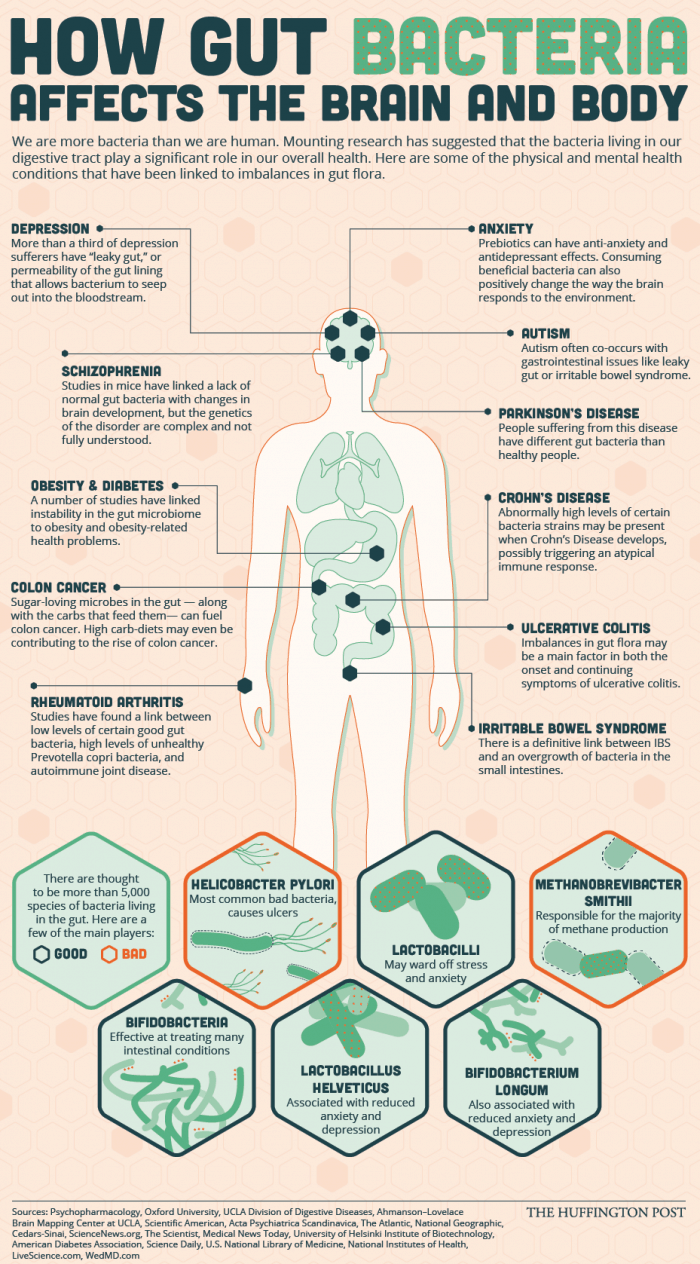


Wow that is impressive, imagine all the diseases and chronic health issues we could change or fix with just the balancing of a patients gut? Your gut?
I know I feel so much better since I have adjusted my diet and started taking a probiotic daily, my immune system has been stronger in the process too.

Until next time.................


Monday, July 6, 2015

The Guide To Good Bacteria: Trillions of Friends


Good bacteria you ask? How can bacteria be good? You have trillions of good bacteria living inside right now, they help keep you well.

With over 100 trillion bacteria in our bodies we need all the good bacteria we can get. 80% of our immune system is in our gut, we need to have a healthy balance of good bacteria for it to fight off the bad.


I recently had a first hand experience that taught me a most valuable lesson about the relationship between my immune system and the good bacteria that lives within me.
Back in January of 2015 I developed a stubborn dental infection that required a stronger antibiotic by mouth for 10 days. After taking this medication I developed some gastrointestinal distress and general feelings of "something was just not right". As a nurse I am very in-tuned to my own body and health so I realized that the antibiotics I had been taking most likely had just wiped out the good bacteria in my gut and the bad bacteria were possibly taking over.
Several weeks went by and my GI issues just got worse, diarrhea, weight loss (15 pounds) nausea, dizziness and just feeling bad all the time. So finally I went to the doctor (nurses are so stubborn), I was diagnosed with C-diff (Clostridium Difficile) a very serious infection of the gi tract that is very difficult to get rid of.

After weeks/months of medications, diet changes and finally a natural medicine/essential oils regimen I was able to get rid of the nasty bug and get well again. Now I tell every patient that I give an antibiotic prescription to get a probiotic and take it every single day. Probiotics will keep the good bacteria in check and healthy, so that your gut can help keep you well.


Friday, November 29, 2013

No Butts About It....Colonoscopy Saves Lives #justdoit

Holy Crap............thats about all I can say about my colonoscopy adventure last week. Nurses are the worst kind of patient, yes tis true. I recently turned another year older and had been putting off this most anxiety producing procedure for several years now. Due to the fact that my family history includes a father who had colon cancer and died with liver cancer, it was a "no brainer" per my internal medicine doctor. I should have had a first screening at age 40...............well just 9 years late, I put my mind to it and got it done.
Yes, I survived and it was not as bad as I had imagined at all.


If you have been putting off having this life saving test done, don't. Besides the prep the night before, it is not all that bad. It is the best test to detect precancerous and cancerous polyps or lesions in your large bowel or colon.
The prep that I endured was called "Suprep" and it was more like a ticking time bomb that went off several hours after I drank the 2nd bottle at 9pm the night before. It did take a couple of Zofran ODT(nausea medication) to get thru the prep, it made me sick on my stomach. It sure does work well though....sheesh. I highly suggest that you plan ahead to stay home and rest while doing your prep. You will go to the bathroom, have some abdominal discomfort and watery diarrhea that can be hard to control until it finally stops. Have a path to the bathroom and place a towel or protective barrier on your bed that night....just in case. I had several uh oh moments when the bathroom was just not close enough..... I told you this stuff worked well.....lol


I arrived at the Endoscopy center at 8am, got my IV started (took 2 sticks as usual, I am a difficult pt I told you) , hooked up to a bunch of monitors, rolled back to the procedure room and the anesthesia staff gave me some happy milk of anesthesia (propofol--Michael Jackson death juice) to sedate me. I don't remember any of the actual procedure and woke up as they rolled me into the recovery area. My hubby was waiting for me there. I felt safe and never embarrassed while I was there. The staff was great and made my experience much calmer and less stressful.


How is the procedure done? 
A colonoscopy is an exam that views the inside of the colon (large intestine) and rectum, using a tool called a colonoscope.
The colonoscope has a small camera attached to a flexible tube that can reach the length of the colon.

How the Test is Performed

You will usually be given medicine into a vein to help you relax. You should not feel any discomfort. You will be awake during the test and may even be able to speak, but you probably will not remember anything.
You will lie on your left side with your knees drawn up toward your chest. The colonoscope is inserted through the anus. It is gently moved into the beginning of the large bowel and slowly advanced as far as the lowest part of the small intestine.
Air will be inserted through the scope to provide a better view. Suction may be used to remove fluid or stool.
The health care provider gets a better view as the colonoscope is moved back out. Therefore, a more careful exam is done while the scope is being pulled back. The doctor may take tissue samples with tiny biopsy forceps inserted through the scope. Polyps may be removed with snares, and images may be taken.
Specialized procedures, such as laser therapy, may also be done.
More information can be found HERE 


Gas is what you will have post-procedure--lots of it, be prepared to toot toot toot it out as instructed by the staff, this is the only time when it is perfectly acceptable to let it all out...lol. You want to expell the gas so you don't have problems later as it rises up and causes pain & nausea. 
I feel very blessed that my colonoscopy results only showed a couple of diverticula areas and no cancerous areas. Now I only have to have this test every 5 years ( due to my family history). Normally it is every 10 years after age 50. 

LinkWithin

Related Posts Plugin for WordPress, Blogger...

Care to Share!